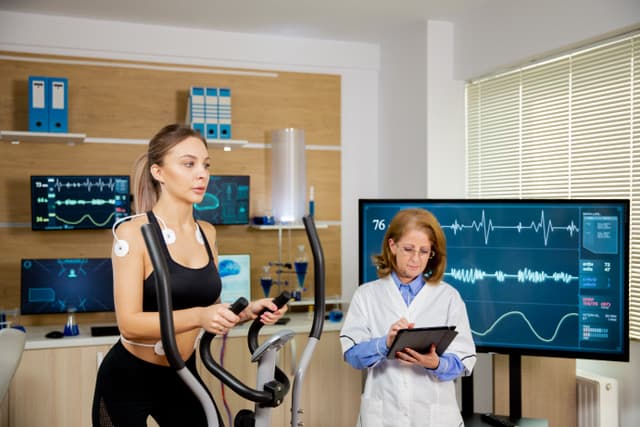
Exercise testing is fundamental in the clinical management of pulmonary arterial hypertension.131,132 The European Respiratory Society listed exercise testing as part of the workup for the diagnosis and treatment of PAH.131 The results from exercise testing are consistently some of the strongest predictors of prognosis in PAH.
Clinicians can use CPET to help identify PAH as a possible mechanism in patients complaining of exercise impairment or with primary lung or left heart disease. The dynamic changes in end-tidal CO₂ and ventilatory equivalent for carbon dioxide (V̇E/V̇CO₂) during CPET capture reduced pulmonary circulation as the right side of the heart begins to fail against the elevated pulmonary vascular resistance in the setting of a reduced peak V̇O₂.132 CPET is one of the few ways to capture the dynamic relationship between pulmonary vascular resistance and right ventricle strength as volume increases. Clinicians use CPET in conjunction with echocardiography or right heart catheterization in order to provide the most clinical information on pulmonary circulation. Exertional hemodynamics and RV contractile reserve are associated with increased risk of hospitalization, reduced quality of life and decreased survival.131
In addition to CPET, six-minute walk testing is the most widely used exercise test in the PAH population and can be useful in assessing prognosis, therapeutic efficacy and listing for transplant.133 Clinicians use exercise not only for diagnostic purposes but also used as a therapy in this population.134,135 Cardiopulmonary rehabilitation improves quality of life metrics, exercise capacity, and in some cases vascular and right ventricle remodeling.
Exercise testing and therapy are core components in the care of patients with PAH. One aspect of the EMD&T training will be to teach clinicians how to interpret gas exchange in physiologically complex patients such as the PAH population and how to prescribe exercise therapy appropriately in high risk and complex populations such as PAH. Comprehending this relationship would provide clinicians with the essential education needed to apply results and therapies appropriately in this population.