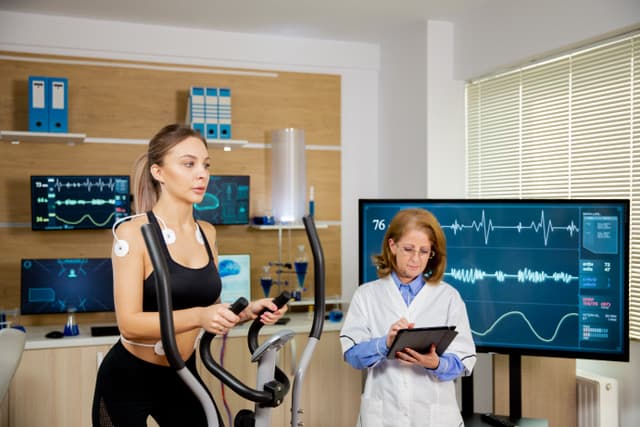
To the pediatric pulmonologist, exertional dyspnea is a common complaint in patients with and without known lung disease. Multiple types of exercise testing, including CPET, exercise laryngoscopy, and exercise challenge testing, are essential tools for evaluation. Comprehensive exercise testing is important to evaluate the contribution of three interrelated aspects of pulmonary physiology in exercise dyspnea, including (1) mechanics of breathing, (2) disorders of gas exchange, and (3) control of breathing. This understanding provides important diagnostic, prognostic, and therapeutic benefits.72
For pediatric patients with disorders affecting airway caliber or chest-wall dynamics, exercise flow volume loops during CPET provide critical information regarding breathing strategy and mechanical respiratory limitation.73–76 CPET with exercise flow volume loops are used to assess the severity of airway compromise and guide surgical intervention in structural airway disorders such as vascular ring and tracheal stenosis.77,78 Flow volume loops also identify low lung volume breathing and flow limitation in obesity,79–84 as well as flow limitation in obstructive lung diseases such as large airway collapse, cystic fibrosis, premature lung disease, and asthma.76,87,186,187
In disorders of gas exchange such as childhood interstitial lung diseases, children often have reduced exercise capacity, and CPET measures of max V̇O₂ and V̇E/V̇CO₂ are better prognostic indicators than other lung function tests.88–91 Additionally, CPET is used to evaluate both hypo and hyperventilation. In congenital hypoventilation syndromes, routine CPET is recommended to establish safe exercise parameters and evaluate therapeutic efficacy of evolving treatment protocols.92,93
Another unique diagnostic tool in pulmonary exercise medicine is exercise laryngoscopy, which involves visualization of the upper airway during exercise to identify structural and dynamic abnormalities causing exercise dyspnea. The prevalence of exercise-induced laryngeal obstruction (EILO) in adolescents may range from approximately 7% to a high of 28% in elite cold-weather athletes.94–97 Exercise laryngoscopy has enabled the detailed characterization of EILO, differentiation of EILO from asthma, and implementation of appropriate therapies.98–100
Finally, exercise challenge testing for identification of exercise induced bronchospasm (EIB) is important in the evaluation of exercise-induced dyspnea. The prevalence of EIB is approximately 10% in the general pediatric population,101 with estimates as high as 50% in cold-weather athletes102 and 46–90% in asthmatics.101,103 Symptoms alone are a poor indicator of airway hyperresponsiveness,95 EIB and other pulmonary disorders often coexist, and understanding of EIB in context requires a broad knowledge base in exercise medicine. EMD&T advanced training program will help address the need for healthcare providers to evaluate and manage exercise-related symptoms throughout the spectrum of health and disease.