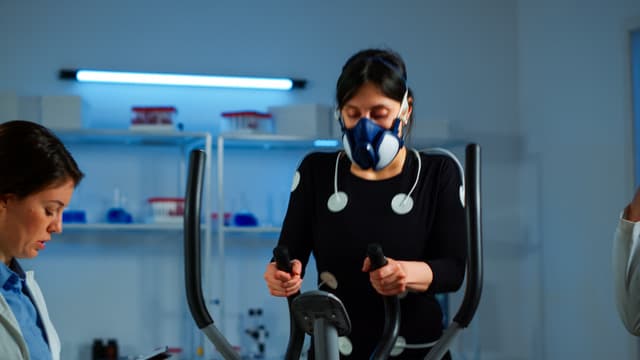
The Advanced Training Program (ATP) in Exercise Medicine Diagnostics and Therapeutics (EMD&T)
A competency-based Advanced Training Program (ATP) in EMD&T designed to integrate with existing subspecialty programs at academic medical centers nationwide.
The AEM Advanced Training Program Launches at Two Sites
Stanford University
Under the leadership of Dr. Inger Olson — Pediatrics / Cardiology
Harbor-UCLA Medical Center
Under the leadership of Dr. William Stringer — Internal Medicine / Pulmonology
The AEM Advanced Training Program
These documents represent the culmination of hard work and discussion among AEM fellows and leaders. They are a work in progress — please share your comments and suggestions as we develop this exciting new program.
Advanced Training Program (ATP) Overview
The ATP is a minimum 1-year training program beyond core specialty or residency, designed for physicians who want to develop advanced competencies in exercise diagnostics, therapeutics, and scholarship.
The advanced training program uses a competency-based progression model built on 6 Entrustable Professional Activities (EPAs), moving trainees from observation through supervised practice to independent clinical competence.
The program is open to physicians who have completed or are completing core residency training in internal medicine, pediatrics, family medicine, or physical medicine and rehabilitation, as well as their subspecialties.
Advanced Training Program
6 Entrustable Professional Activities
The advanced training program curriculum is built on 6 EPAs that define the competencies trainees must achieve, with a 5-level supervision scale from direct observation to unsupervised independent practice.
Design & Oversee Clinical Exercise Evaluation
Select, conduct, interpret, and report standardized exercise assessments including CPET, muscle strength tests, and physical performance evaluations.
Laboratory Organization & Technical Operations
Engage in the organization, technical operations, and quality control of clinical exercise and physical performance laboratories.
Exercise Medicine Consultation
Provide clinical consultation to other medical professionals regarding exercise capacity, limitations, risks, and intervention options.
Exercise Prescription in Health & Disease
Provide exercise prescriptions for training or rehabilitation across a range of diseases and pathophysiology, as well as general health maintenance.
Expert Advisor & Advocate
Serve as an expert advisor on exercise within healthcare institutions and in community-based environments and programs.
Scholarship in EMD&T
Demonstrate scholarship through research, teaching, quality improvement, and evidence-based clinical practice.
Supervision Scale: Each EPA uses a 5-level entrustment scale — (1) Observation only → (2) Direct supervision → (3) Indirect supervision → (4) Oversight with autonomous execution → (5) Unsupervised independent practice. Progression is competency-based, not time-based.
Complements Existing Programs
EMD&T does not replace existing subspecialties — it fills a knowledge gap to augment current training.
Academic Representation Within the AEM
Inaugural Sites for Program Starting in 2026
Harbor-UCLA Medical Center
William Stringer, MD, Kathy Sietsema, MD
Stanford University
Inger Olson, MD